BOOK ONE
Ragionamento che fa l'autore M. Bartolomeo Scappi con Giovanni suo discepolo.
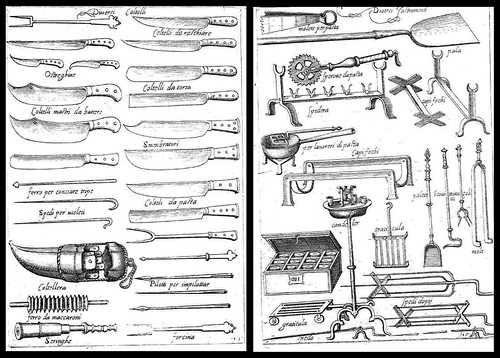 |
| Left: Various Knives Right: Kitchen Apparatus, 2 Photo: bibliodyssey.blogspot.ca |
 |
| Left: Various Utensils, 1 Right: Various Utensils, 2 Photo: bibliodyssey.blogspot.ca |
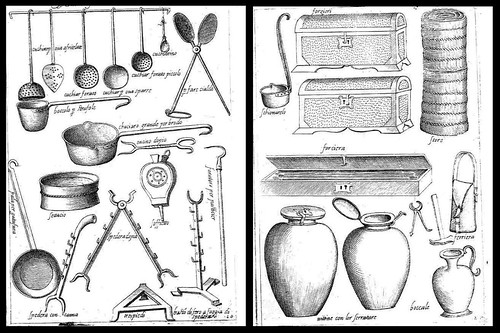 |
| Left: Kitchen Apparatus, 3 Right: Kitchen Equipment for Travelling (Photo: bibliodyssey.blogspot.ca) |
BOOK TWO
Diverse vivande di carne, si di quadrupedi, come di volatili
In this book, the focus is on preparing various types of meat dishes. I enjoyed recipe 7, to make Venetian bresaola of grilled beef ribs: Get a rack of ribs of a fat ox or cow, of mature age, slicing it apart rib by rib. With the flat of a large knife press each of them, spreading them out a little, and beat them with the spine of a knife on one side and the other: that is done so that the meat will be softer and more tender. Then they are splashed with rose vinegar, and sprinkled with pepper, cinnamon, salt, fennel flour or coriander. Pile them up on one another under pressure for six hours, more or less, depending on the time you have. Cook them slowly on a grill, turning them over occasionally, with a slice of pork fat on each so they do not dry out. When they are done, they need to be served with a garnish of vinegar, sugar, cinnamon, cloves and nutmeg on top. You can do the same with a rack of ribs from a wether, a weaned calf and a suckling or free-ranging calf.
The detail that Scappi places in his recipes, and the careful instruction, gives a sense of him wishing whoever that reads his work understands each and every process there is to preparing a meal like this. All his recipes call for the same level of attention to detail. And not only does he present one singular way to prepare a certain cut of beef but he begins a number of his recipes with "Several ways to cook" or "Various ways."
He then goes into detail about the different fowls and methods to prepare those and ways to prepare different dishes composed of grains, nuts, pasta, and legumes. Which seem to end in recipes of soup!
Book two ends off with various recipes of jellies and sauces. I can present a short sauce here:
259. to prepare a sauce of fresh visciola cherries or of other fruit.
Get four pounds of fresh Roman cherries that are not too ripe, and cook them in a pot with two-thirds of a litre of verjuice, two ounces of fine mostaccioli, four ounces of breadcrumb, a little salt, a pound of sugar and an ounce of pepper, cloves, cinnamon and nutmeg together. When it is done, put all of it through a strainer and let it cool. Serve it. You can do gooseberries and mulberries the same way.
BOOK THREE
Vivande che appartengono alli giorni di magro et quadragesimali
This book has a focus on "lean dishes," which includes sea, freshwater and preserved fish, frogs, turtles, crustaceans, molluses, and different types of vegetables (eggplants, broccoli, cauliflower, etc.). Scappi also takes time to speak about the season and look of specific ingredients
191. The appearance and season of razor clams
Razor clams are of two sorts: white and black. In some places they are called spoletti. They are covered with a smooth rippled shell half a palm's width, more or less, in length, depending on their size. They look like a small reed and in that reed is the clam which is long rather like a ligament. A large number of them are caught in the port of Civita Vecchia, and near Chiozza, too; few are brought to Rome, though. They are caught with an iron fork, but those caught in a net are better because they are not so full of sand. They are tougher than a cockle. Their season begins in October and goes to the end of April.
Then he teaches you how to prepare these clams!
192. Several ways to cook razor clams.
Get razor clams that are alive, because otherwise they are worthless, and let them steep for two hours in saltwater or salted freshwater that is slightly warm: you do that to get the sand out of them. Take them out of the water, coat them in oil and cook them on a grill. When they have opened fully, bathe them in oil mixed with orange juice and pepper. Serve them hot.
If you want them in a pottage, bring them to a boil; alternatively, when they are half cooked on the grill remove them from their shell and make a pottage of them. Braise them the way oysters are done in recipe 186.
They can also be fried after they are taken out of their shell. Those are served garnished with sautéed parsley and orange juice, or else dressed with a variety of garnishes. And you can make a variety of pastry dishes with them, as is said in the book on pastries.
Another neat aspect of his cookbook is how he relates numerous recipes back to one another. I just can't seem to be grateful for the amount of detail he puts into his cookbook. As with the specification of the season, colour, and location for the razor clam, it feels as if, for whoever reads this, truly gets a large amount of information out of it.
This post is also becoming a tad tooo long, so I'll finish off books four-six in the following post!
All photos from: http://bibliodyssey.blogspot.ca/2009/03/renaissance-kitchen.html
All recipes and main source: Scappi, Bartolomeo. The Opera of Bartolomeo Scappi (1570): L'arte et prudenza d'un maestro Cuoco. Trans. Terence Scully. Toronto: University of Toronto Press, 1570. Print.

No comments:
Post a Comment