Friday, 4 December 2015

Even More Tips, Tricks and Recipes!


Let's dive right back into the rest of Bartolomeo Scappi's books!

BOOK FOUR
Dell'imbandire le vicande
This book deals primarily with the preparation and serving of meals to men of notable status. Scully does mention how Scappi must have been present during important meetings and during gatherings of notable officials. I found that this is proven by one simple line, "you will often have to deal with stewards whom their masters have installed in their Office more as favour than for any experience they might have of that function." I say this line proves how present Scappi was, especially with his status as a master chef for wealthy families, because he offhandedly comments on the corruption of the government within the Italian city states!
Scappi states, for book four, it will be a list "of things that can be served from month to month, things normally eaten in Italy and particularly in the City of Rome." Scully does not translate the samplings of the menus Scappi presents (unfortunately). So, for the sake of brevity (and the possibility of horrid translations) I will present two portions of one meal. A Dinner on the 8th of April, with two Credenza courses and one Kitchen course, served in two plates, with two Stewards and two Carvers (Pranzo alli VIII d'aprile con due servitii di credenza, & un di cucina servito a due piatti con due Scalchi, & due Trincianti).

Primo servitio di credenza
Biscotelli di marzapane               2 piatti
Mostacciuoli Napoletani             2 piatti
Ricotte passate er la siringa servite con zuccaro sopra             2 piatti
Presciuto cotto in vino tagliato in fetter, servito con               2 piatti
  sugo di melangole, & zuccaro sopra              
Offelle alla Milanese             2 piatti

Secondo, & ultimo servition di credenza
Torte di salviata             2 piatti
Tore bianche             2 piatti
Carciofani cotti serviti con aceto, & pepe             2 piatti
Carciofani crudi serviti con sale, & pepe             2 piatti
Pere, & mele di piu sorti             2 piatti
Casci marzolini di due libre l'uno spaccati             2 piatti
Casci Parmeggiano in fettuccie             2 piatti
Mandoline fresche spaccate servite su le foglie de vitti             2 piatti
Neve di latte servita con zuccaro sopra             2 piatti
Cialdoncini fatti a scartocci             2 piatti
Ciambellette di monache             2 piatti

and the rest of book four goes on like this. The detail and attention, and even the fact that he recorded all this down, is simply amazing to me!
Opera di M. Bartolomeo Scappi (1570) f
Left: Kitchen Apparatus, 3 Right: Kitchen Equipment
for Travelling
 (Photo: bibliodyssey.blogspot.ca)
He then speaks about more kitchen equipment (yes, there is more!) but for travelling instead. This picture was in the previous post, but on the right hand side is are images of what can be used for travelling. The list for travelling has similar components to the earlier list of what should be in the kitchen. When reading the list, there seems to be a sense of one must be prepared for anything that their master may wish to eat on the road.


BOOK FIVE 
Delle paste
This book is about the preparation of different pastries like, pies en croute, crostate, tourtes, twists, flans, pizze, lean pies, lean crostate and tourtes (lean being made mostly out of fish). To be honest, I thought that this book would contain a lot more desserts, but for the most part, the main ingredient is still a meat. There are turkey pullets in pies, a pie of a calf liver, and a prosciutto crostata (just to name a few). There are a sweet pastry recipes included in this section, we have recipe 124. Another way to prepare a filled twist
When you have made a sheet of dough like the one above, grease it with melted butter and sprinkle it with sugar and cinnamon. The get hard-boiled egg yolks beaten small and mixed with steeped pinenuts and raisins, and scatter a few little bits of butter on top of that. Make a twist and bake it as above in the oven in a tourte pan (one of the other ways to make a twist was using bone marrow!).
The reason why pastries were not just simple, sweet desserts may be a way that the people in the renaissance wanted each portion of the meal to be equally as filling. That is why a majority of these recipes are not simple by any means and always seem to contain a long list of ingredients.

BOOK SIX
De convalescenti
The dishes in this book are for those that are sick (a strange section for a cookbook, I say). Listed recipes are for prepared potions, concentrates, pastes, barley gruel, thick broths, thick soups, pies, tourtes, sops, milk dishes, eggs, dainty pottages, fruits, sauces, garnishes, jellies and confections. The list of different recipes is quite long, it covers a large range of dishes but each section does not have the large number of recipes as the other sections. As I read the recipes it seems that the main idea for most of them is to give a concentrated meal but one that was also easy to digest.
For example, recipe 58. to prepare a thin barely gruel
  Get either of the above-mentioned barleys and clean it the same way. Cook it in a pot, with two and two-thirds litres of water for every pound of barley. Reduce it by two-thirds so that the remaining water is a tawny colour and thick. Put the barley into a filter cloth and immediately discard the water that comes through first. Carefully squeeze the cloth and tie it up; hang it over a nail and the water that oozes out will, according to Physicians, be excellent. To that barley gruel you can add melon seeds, reduced milk, and sugar.
I like how he mentions what Physicians say, it adds an air of authority and true evidence that his food will provide some relief to those that are ill. Scappi also has some simpler meals, like recipe 90. the prepare a thick spinach soup.
     Get spinach in the spring, although in Rome you can find it an any time of the year. Wash it in several changes of water, taking the tenderest part. Sauté it in oil or butter or chicken fat. Then finish off cooking it in chicken broth and prunes. Serve it hot with its broth.
There is still a sense of this meal being fulling but it is simple and easy for one to eat and digest (I assume it would be a dish that is easier on the stomach as well!)

This concludes Bartolomeo Scappi's Opera! Wasn't it an exciting trip? I find that this much attention to detail may be a sign of master chefs throughout Europe, but I'm not too sure. I do know that in the mid 14th century to the early 15th century, in Italy, documentation starts gaining ground. You have the merchants writing every detail of their transactions (when, who, what, why) and we can see this with one of the most influential merchants, Francesco Datini (c.1335-1410). Who had an amazing storage of all his economic transactions that survived, in house. Perhaps the chefs are responding to this type of documentation in their own way by means of a cookbook. What better way to preserve recipes and one's own name?
Though in the case of Scappi, it seemed his station as a papal chef allowed him the means to write such a book.
His book is still a nice snippet into the dining rooms of wealthy courts, papal courts, and even at the side of ailing popes.


Photo: http://bibliodyssey.blogspot.ca/2009/03/renaissance-kitchen.htmlScappi, Bartolomeo. The Opera of Bartolomeo Scappi (1570): L'arte et prudenza d'un maestro Cuoco. Trans. Terence Scully. Toronto: University of Toronto Press, 1570. Print.

Thursday, 3 December 2015

Tips, Tricks and Recipes of the Trade!

So, our master chef, Bartolomeo Scappi has been introduced. I will present briefly write about each book in Scappi included and as to why he might have included certain aspects. As well as the images of the kitchen tools he added to his cookbook as well... Let's begin!

BOOK ONE
Ragionamento che fa l'autore M. Bartolomeo Scappi con Giovanni suo discepolo. 
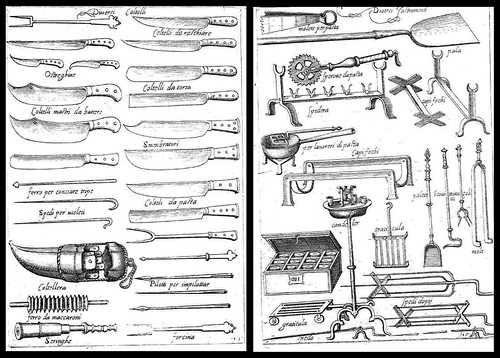
Opera di M. Bartolomeo Scappi (1570) d
Left: Various Knives Right: Kitchen Apparatus, 2
Photo: bibliodyssey.blogspot.ca
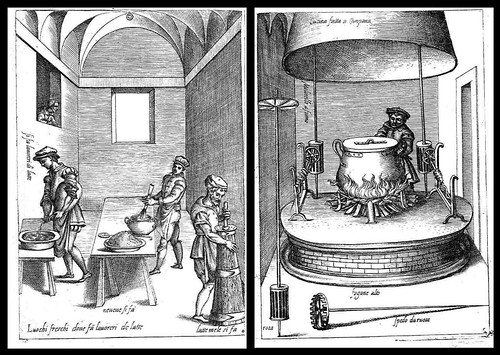
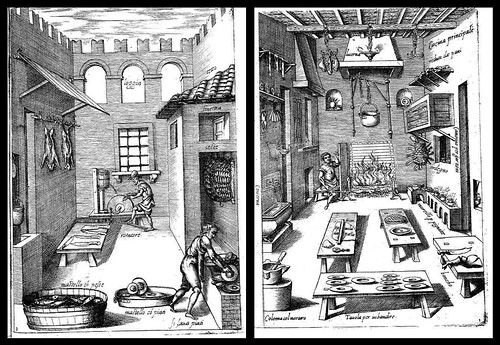
Well, the first book is not presenting us with any forms of recipes. The main focus on this book is the conversation Scappi has with his apprentice Giovanni. Scappi has about 44 sections about what a master chef should embody in all aspects of his life. Scappi speaks in detail about where the kitchen should be set and how it should be designed. He speaks that the location should avoid distractions from the public eye, it should be airy so that it does not become stifling. The advice he presents for the kitchen is one of an ideal kitchen. If one has the space and the means to do so, then he should strive to make his kitchen so. I say this because he starts off most paragraphs, with "I think.
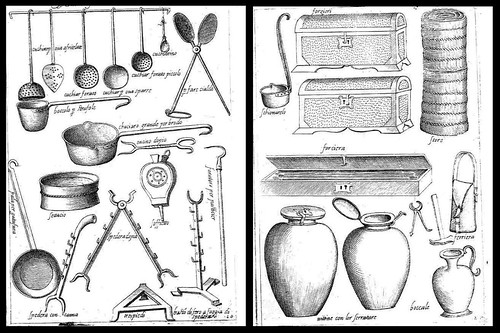
Opera di M. Bartolomeo Scappi (1570) c
Left: Various Utensils, 1 Right: Various Utensils, 2
Photo: bibliodyssey.blogspot.ca
He then begins a lengthy discussion on how to tell how good particular food items are. For example, "20. To tell how good honey is. To be good, honey should be fine-grained, firm, heavy, of a good smell, and with a golden colour. Above all it should be clean. It is stored in wooden or earthenware vessels(113). Scappi also wants to drive home the idea of experience and how through actually learning and attempting these things on his own, through various kitchens, he has gained the knowledge to make a cookbook like this with such detailed instructions. Preservation is also a large focus of Scappi (and it should!) because, as we know, fridges were not used to keep their meat! They had to find methods to make their meat last for as long as they could without it going bad.
Opera di M. Bartolomeo Scappi (1570) f
Left: Kitchen Apparatus, 3 Right: Kitchen Equipment
for Travelling
 (Photo: bibliodyssey.blogspot.ca)
         From point 43 and onwards his attention is now focused on the types of instruments one should have in his kitchen at all times. He has a list for the proper iron equipment, which seems to go detail of the little things, like "Pastry knives. Skinning knives. Knives of carious sorts with their sheath of boiled leather. Hooks of carious sorts for removing meat from a cauldron. Balance scales, like a spicer's, with weights, to weigh out spices"(124-125). And so much more, including a list for copper equipment, and even a section for the the stamps and moulds for both the Master Chef and Pastry Chef.


BOOK TWO
Diverse vivande di carne, si di quadrupedi, come di volatili 
In this book, the focus is on preparing various types of meat dishes. I enjoyed recipe 7, to make Venetian bresaola of grilled beef ribs: Get a rack of ribs of a fat ox or cow, of mature age, slicing it apart rib by rib. With the flat of a large knife press each of them, spreading them out a little, and beat them with the spine of a knife on one side and the other: that is done so that the meat will be softer and more tender. Then they are splashed with rose vinegar, and sprinkled with pepper, cinnamon, salt, fennel flour or coriander. Pile them up on one another under pressure for six hours, more or less, depending on the time you have. Cook them slowly on a grill, turning them over occasionally, with a slice of pork fat on each so they do not dry out. When they are done, they need to be served with a garnish of vinegar, sugar, cinnamon, cloves and nutmeg on top. You can do the same with a rack of ribs from a wether, a weaned calf and a suckling or free-ranging calf.
The detail that Scappi places in his recipes, and the careful instruction, gives a sense of him wishing whoever that reads his work understands each and every process there is to preparing a meal like this. All his recipes call for the same level of attention to detail. And not only does he present one singular way to prepare a certain cut of beef but he begins a number of his recipes with "Several ways to cookor "Various ways."
He then goes into detail about the different fowls and methods to prepare those and ways to prepare different dishes composed of grains, nuts, pasta, and legumes. Which seem to end in recipes of soup!
Book two ends off with various recipes of jellies and sauces. I can present a short sauce here:
259. to prepare a sauce of fresh visciola cherries or of other fruit.
     Get four pounds of fresh Roman cherries that are not too ripe, and cook them in a pot with two-thirds of a litre of verjuice, two ounces of fine mostaccioli, four ounces of breadcrumb, a little salt, a pound of sugar and an ounce of pepper, cloves, cinnamon and nutmeg together. When it is done, put all of it through a strainer and let it cool. Serve it. You can do gooseberries and mulberries the same way.

BOOK THREE
Vivande che appartengono alli giorni di magro et quadragesimali
This book has a focus on "lean dishes," which includes sea, freshwater and preserved fish, frogs, turtles, crustaceans, molluses,  and different types of vegetables (eggplants, broccoli, cauliflower, etc.). Scappi also takes time to speak about the season and look of specific ingredients
191. The appearance and season of razor clams
Razor clams are of two sorts: white and black. In some places they are called spoletti. They are covered with a smooth rippled shell half a palm's width, more or less, in length, depending on their size. They look like a small reed and in that reed is the clam which is long rather like a ligament. A large number of them are caught in the port of Civita Vecchia, and near Chiozza, too; few are brought to Rome, though. They are caught with an iron fork, but those caught in a net are better because they are not so full of sand. They are tougher than a cockle. Their season begins in October and goes to the end of April.
Then he teaches you how to prepare these clams!
192. Several ways to cook razor clams.
Get razor clams that are alive, because otherwise they are worthless, and let them steep for two hours in saltwater or salted freshwater that is slightly warm: you do that to get the sand out of them. Take them out of the water, coat them in oil and cook them on a grill. When they have opened fully, bathe them in oil mixed with orange juice and pepper. Serve them hot.
   If you want them in a pottage, bring them to a boil; alternatively, when they are half cooked on the grill remove them from their shell and make a pottage of them. Braise them the way oysters are done in recipe 186.
  They can also be fried after they are taken out of their shell. Those are served garnished with sautéed parsley and orange juice, or else dressed with a variety of garnishes. And you can make a variety of pastry dishes with them, as is said in the book on pastries.
Another neat aspect of his cookbook is how he relates numerous recipes back to one another. I just can't seem to be grateful for the amount of detail he puts into his cookbook. As with the specification of the season, colour, and location for the razor clam, it feels as if, for whoever reads this, truly gets a large amount of information out of it.

This post is also becoming a tad tooo long, so I'll finish off books four-six in the following post!


All photos from: http://bibliodyssey.blogspot.ca/2009/03/renaissance-kitchen.html
All recipes and main source: Scappi, Bartolomeo. The Opera of Bartolomeo Scappi (1570): L'arte et prudenza d'un maestro Cuoco. Trans. Terence Scully. Toronto: University of Toronto Press, 1570. Print.


A Master Chef?!

Photo: wikipedia.org
Well, let's move on from paintings (not to fret, we'll come back to them later) and focus on a master chef from the time! His name (drum roll please) is Bartolomeo Scappi (c.1500 - 1577). He worked for various cardinals and numerous Popes, like Pope Pius IV, Pius V and Paul III. Aside from these figures, most of his dishes were "served and enjoyed in wealthy courts of refined taste throughout the Italian states" (Scully). Terence Scully states that by 1536 we can be certain that Scappi has already established himself as a master chef among the courts.
There is very little concerning time dates with him but we do know that he made a cookbook, titled The Opera of Bartolomeo Scappi. 
Or, as Terence Scully comments in his book, the full title, on the first and second printing of the book is:
OPERA SI M. BARTOLOMEO SCAPPI, CUOCO SECRECTO DI PAPA PIO QUINTO, DIVISI IN SEI LIBRE.
Nel primo si contiene il ragionamento che fa l'Autore con Gio. suo discepolo.
Nel scondo si tratta di diverse vivande di carne, si di quadrupedi, come di volatili.
Nel terzo si parla della statura, e stagione de pesci.
Nel quarto si mostrano le liste del presentar le vivande in tavola, cosa di grasso come di magro. 
Nel quinto si contiene l'ordine de far diverse sorti di paste, & altri lavori.
Nel sesto, & ultimo libro si ragiona de' convalescenti, & molte altre sorti di vivande per gli infermi.
Con il discorso funerale che fu fatto nelle essequie di Papa Paulo III. 
Con le figure che fanno bisogno nella cucina, & alli Reverendissimi nel Conclave.

Photo: bibliodyssey.blogspot.ca
Neat, eh? The whole of the contexts of the book was considered apart of the book title. And a fun little fact was that the main printing pressing for Italy at this time were situated in Venice. 
What also makes his cookbook interesting is the detailed attention he places on the ingredients he works with. Scully writes, "not only does he examine the nature of the best meats, fowl, fish, fruits and vegetables, as Platina (an earlier fellow who participated in an earlier tradition of recipe collections) did in a sketchy way, but he also follows the foodstuff through the kitchen, from the time a skinned carcass, a whole fish in brine or an artichoke arrives at the stage at which it can be cut up and cooked. He demonstrates a butcher's intimate knowledge of a carcass as he specifies exactly where a prime or secondary cut of meat is located; he describes how to isolate a fish's 'umbilicus'; he directs the cook's knife to discard all but the desirable part of a carrot." He also, unlike earlier recipes "that specify beef do not distinguish a steer from a cow, as Scappi does." I'll be getting more into the recipes in the next blog post, but doesn't this get you excited? I know I'm excited to see his recipes (and even try a few at home!). 
Quick touch on the spices used, Scully comments that, "sugar, growing in use from the beginning of the fifteenth century, now dominates, and almost collapses, the spice shelf of Scappi's kitchen. It is mentioned in more than 900 of his recipes."-- his note, on pg. 60, lets us know that sugar cane became a major crop on the island while it was under Venetian and Lusigan rule. There was growth for demand, so Venice did a good job getting on that sugar cane production. 

Scappi also provides us with visuals about the kitchen and about the tools used in the kitchen. Let's take a look at the rooms/sections of the kitchens and the tools with the recipes next post. 
Opera di M. Bartolomeo Scappi (1570)
Left: Cool Place for Dairy Products Right: Cooking under a Hood (Photo: bibliodyssey.blogspot.ca)
Opera di M. Bartolomeo Scappi (1570) Cucina Principale
Left: The Main Kitchen Right: The Room Next to the Kitchen (Photo: bibliodyssey.blogspot.ca)
I do not know whether these depictions are representative of all kitchens in the homes of the wealthy or if this was simply the kitchen that was provided to a well known master chef as Scappi. We must keep in mind that he worked for Popes and Cardinals. What we can gain from this, is that most kitchens wished to keep their rooms separate like (it would be ideal). Yet, if we look back to Campi's Kitchen, it seemed that most kitchens were cramped as he portrayed rather than how Scappi is presenting the kitchens in his cookbook.


Bartolomeo Scappi Photo: https://en.wikipedia.org/wiki/Bartolomeo_Scappi
All other photos: http://bibliodyssey.blogspot.ca/2009/03/renaissance-kitchen.html
Scappi, Bartolomeo. The Opera of Bartolomeo Scappi (1570): L'arte et prudenza d'un maestro Cuoco. Trans. Terence Scully. Toronto: University of Toronto Press, 1570. Print.


More Campi!

Well, those were some visuals last post, eh? Let's take a look at the second series Vincenzo Campi produced for the unknown patron. Some more exciting paintings depicting vendors and, once again, the figures in his paintings are of lay people. Not aristocrats or merchants, just your regular lay people selling their food and even eating some cheese!

Vincenzo Campi, Fruit Vendor (Photo: ARTstor, SCALA, Florence/ART RESOURCE, N.Y.)
First off, we have a lovely fruit vendor with another succulent display of numerous fruits and what seems as a few vegetables here and there. Going back to McTighe's article, she states how these paintings present the genders in quite different manners. We have the female figures, like the fruit vendor displaying her own 'plumpness' with that of peaches on her lap. I also find that the fact the fruit vendor is a female displays her fertility and her natural ability to produce. On a side note, as we can see in the background, two figures are picking fruits and I find that Campi not only is able to show the yield of a good harvest but, subtly, show the manner in which the foodstuff is gathered. McTighe also points out, in the Poulterers, that the boy is shown with a grotesque face but the woman, who has the bird bearing it's breast and genitals heightens her sexuality and the overall feeling of the painting.

Vincenzo Campi, Poulterers (Photo: SCALA, Florence/ART RESOURCE, N.Y.)

Vincenzo Campi, Kitchen
(Photo:SCALA, Florence/ART RESOURCE, N.Y.)
Another intriguing point I found that McTighe brought up was that, looking at the Kitchen painting, "the composition teems with actions that bring the lower-class figures into dangerous intimacy with foods that would transgress the boundaries of a working person's diet." I had not quite thought about it in this manner before. Yes, 'lower-class figures' are meant to work for the wealthy and handle objects that these figures would never dream of seeing, let alone touch. Food, on the other hand, is very intimately prepared. It is constantly being touched, even taste the food to make sure that it is up to par to what the wealthy would expect. Yet, as the painting shows, the preparation of the food is done in an environment that is simply filled with the hectic life of the lower-class. It is cramped, food is on the floor, a child aids, and there are animals fighting on the floor as well. And in the background we see a neatly prepared dining table that does not reflect the manner of preparation seen in the foreground.

Vincenzo Campi, Fish Vendors(Photo: SCALA, Florence/ART RESOURCE, N.Y.)
I very much enjoy the next two paintings! I very much am fond of the family portrayal where the father, mother, and child are on the left hand side of the painting titled Fish Vendors. I assume that the girl on the right is the daughter of this family as well. Campi, I find once again, captures a very active moment in a lay person's life and is still able to capture all the movement and energy of the figures. I also seemed to have yet to mention the amount of detail he places in all his paintings! The numerous fruits, birds, and fish he uses is outstanding and each and every one of these are all equal in detail.


The same applies to the Ricotta Eaters, where the eating of the ricotta has tone of celebration and we see the lay people actually engaging with the food in an entirely different manner than what we have previously seen! They are not preparing the ricotta or are presenting it to sell. They are enjoying the taste of the ricotta and are indulging their sense of taste. I find that this painting may be my favourite because, as McTighe stated the lay people and the boundary they may have with what they were preparing earlier in the Kitchen, such things are not present in the Ricotta Eaters. This may also have to do with the lack of background, the focus is simply on the activity of eating. Yet, I find that this lack of boundary, the ability to indulge in the intimacy, also leads to a sense of overindulgence. The man on the left of the painting seems to have be eating too much and still continues to feast on the ricotta, disregarding his limit. I also find that as the men eat the ricotta it makes me want to eat it as well, and as the figures stare at you, they invite you to partake in eating the ricotta as well. Overall, I just enjoy this one the best.
Vincenzo Campi, Ricotta Eaters (photo: cheesesolidarity.wordpress.com)
This ends our tour of the paintings of Vincenzo Campi! He is an amazing artist and I cannot wait to look at more paintings that deal with food and feasts! 
Oh, on a note about the painting of the Poulterers, in both this post and the previous post. They are the same painting. I could not find the proper one for series one because of them being so similar I mistook series two for series one. McTighe's article has both of these paintings but I was also unable to figure out how to get the article photos onto my blog. Apologies for the mistake but (in my opinion) the paintings are too eerily alike!


McTighe, Sheila. "Foods and the Body in Italian Genre Paintings, about 1580s: Campi, Passarotti, Carracci." The Art Bulletin 86.2 (2004): 301-323. JSTOR. Web. 16 Nov. 2015.

Monday, 30 November 2015

Those food visuals

The previous post was all text based. Let's move on to some visual representation of food. The artist in focus is Vincenzo Campi (1536-1591). I decided to focus on Campi as a result of not being able to find much on peasants and their diets (and dealing with food) during the Renaissance. Luckily, in attempting to find the reason why these paintings were painted, I found an article, written by Sheila McTighe, titled Foods and the Body in Italian Genre Paintings, about 1580: Campi, Passarotti, Carracci. And, as we can see from the article title, lead me to a few other artists as well!
As McTighe states, the series of 5 paintings were for the patronage of the Fugger family of Augsburg, in ~1580. He also had a later unknown patron, who also requested a series of 5 paintings. Both series present fruit and fish vendors, poulterers, and the second series containing cheese eaters as well. So, let us get into his first series.

Vincenzo Campi, Fish Vendors (Photo: Jstor)
A real focus for these series of paintings is the theme they present. There are not many paintings, even writing, from this period that explain or show what or how lay people worked, or ate, their food. I understand that there is an understanding that lay people did not have the best diet and the threat of famine was a constant -- there always seems to be a sense of pity and despair. But Campi portrays the husband and wife as cheerful people and are full of life. Perhaps it was the way in which the patron asked for the figures to be presented, but we must keep in mind that lay people did thrive in some years when harvest or fishing were yielded a large amount of produce.

Vincenzo Campi, The Fruit Vendor (Photo: reproarte.com)

There's a large abundance of foodstuff in which the lay people present. I found this a tad interesting because, even if they had this large amount of food available to them, they would not be able to indulge in the food. The food is tangible evidence of their hard work on the fields and though they needed to survive, and did eat some of their product but ideally selling most of it would come first. Yet, this also brings me to ask, would they have had this much food as the result of a harvest? Some more research will have to go into this.


Vincenzo Campi, Fishmonger (Photo: bjws.blogspot.ca)
 What McTighe points out though, is that this particular theme of painting is similar to Flemish market scenes by Antwerp painters Pieter Aertsen and Joachim Beuckelaer. A point of interest, as McTighe also points out, is that the Italian paintings have a lack of biblical motifs in the background. Which, for me, could be seen as the Italian painters depicting the how fruitful the peninsula is and the diversity they had in the food stuff present.
Vincenzo Campi, Poulterers (Photo: ARTstor)

I also find that the paintings do well to show the dynamic of the family. In three out of the five paintings we see a child, either in the lap of the mother or aiding his mother (like in the Poulterers). Campi also presents the joy that the husband and the wife share while presenting their foodstuff. The feeling of the portraits are intimate in the way that the figures interact. The husband and wife jesting is also something that I enjoy in his paintings. Unlike some other paintings, like biblical passages, where the placement of figures are thoroughly thought about and the inclusion of patrons, or the artists themselves, give the paintings a static sense to them (at least to me they do).

Vincenzo Campi, Fish Vendors (Photo: Witt Library, Courtauld Institute of Art)
With these paintings, Campi captures a moment of time, a simple snapshot, of people enjoying moments from their daily lives. The background, as mentioned above, is may not be biblical in meaning but what comes to mind is a sense of these lay people being immersed in nature. Their lives are constantly surrounded by nature, be it growing the animals or ploughing and sowing the fields. Their lives are dependent on what nature gives them in exchange for their hard work. 

This post is getting a little long so I will pick up Campi's second series, commissioned by an unknown patron, in the following post to come! Stay tuned!


McTighe, Sheila. "Foods and the Body in Italian Genre Paintings, about 1580s: Campi, Passarotti, Carracci." The Art Bulletin 86.2 (2004): 301-323. JSTOR. Web. 16 Nov. 2015.

Thursday, 26 November 2015

The Court of Ferrara (1529)

Let's jump right into the Renaissance dining and the court of Ferrara! For this particular court feast, we will be aided by John Dickie and a section of his book Delizia!: The Epic History of the Italians and Their Food. The feast that took place in 1529, was recorded in extreme detail by the court administrator and steward to the Dukes of Ferrara, Cristoforo da Messisbugo (79). The feast was to celebrate a crucial rite of passage for Alfonso I, the Duke of Ferrara (80). What Dickie notes for this feast is the overindulgence of food and just the simple sense of excess. A sense of excess that is still overdone, even if the number of guests reaches 104! What I found extremely interesting about this section of Dickie's book, is the amount of detail taken to record not only the amount of dishes made, but details on how each dish was prepared.

Ah, but first I think it would do well to understand the structure of a traditional Italian meal before we get to the number of courses throughout the feast. Messisbugo has a starter and four courses written down (five courses total!). This may seem as a substantial amount of food, but it is not so much considering how the Italians structured their meals.
  • The Antipasto: something small to nibble on before the actual meal
  • The Primo (or Primi Piatti): usually consist of starches, like pasta or risotto or so
  • The Secondo (or Secondi Piatti): the main meat of the course, ranging from fish to lamb or pork or beef
  • The Contorno: a side dish of vegetables that compliments the main meat dish, tends to bring out the simplistic flavours of the vegetables
  • The Dolce: a sweet or dessert that ends off the meal
Yet we must keep in mind, the feast at Ferrara does not display how all the courts throughout the city-states of Italy dined on feast days, or on any given day. As Dickie mentions, "grand court dinners offered the chance for a steward, as well as his master, to put all his capabilities on show" (80). And so, "Messisbugo's meal was given its real savor by a mix of power and spectacle" (80). As such, we can grasp a better understanding of why Messisbugo went to such great lengths to present the guests with all these lavish dishes. The feast not only allowed Messisbugo to parade the wealth, and power, of his Duke but to also show how well off the city-state of Ferrara was as a whole.

It would be too much to put the entirety of the menu up onto this one post, but I will show a dish or two from each course. And, as you will see, just a few examples will show the extravagance of such a grand feast!

STARTERS
104 small cream pies dusted with sugar
15 large salted eels, in 104 cylindrical cuts. 25 plates
       Eels were the king of Italian fish in the Middle Ages and Renaissance. They could be kept alive a long time in freshwater reservoirs in the cities, and responded well to salting and smoking.
50 large, skinned, smoked grey mullet in 25 pies with sweet sauce

FIRST COURSE
104 quails. 104 tomaselle. 104 roasted capon lives in caul. With accompaniments. 25 plates
       Tomaselle were liver rissoles made with raisins, sugar, bone marrow, spices, and hard cheese, then wrapped in caul or omentum -- a double folded fatty membrane from an animal's lower abdomen that was often used as sausage skin
52 roast pheasant with 100 oranges in segments. 25 plates.

SECOND COURSE - Dickie makes a note of how the dishes begin to increase with sophistication (89)
25 fried white sausages. 104 fried sweetbreads, sprinkled with sugar and cinnamon. 25 plates.
       Cervalleti (white sausages) contained a stuffing of milk, egg whites, fatty cheese, starch, sugar, raisins, cinnamon, and pepper. They were boiled and then fried in fat. 
257 large pigeons in puff pastry. 25 plates.
104 friend Lake Garda trout, sprinkled with sesame seeds. 

THIRD COURSE
104 roast, boned partridges in a "royal sauce" of sugar, vinegar, and spices. 25 plates.
23 rabbits. 104 doves. Thickly sliced large yellow sausages. 25 plates.
      The yellow sausages were made with pork, Piacenza cheese (a variety of Parmesan) and spices. About eleven pounds of sausage were divided between the 25 plates. 
25 plates of large, fresh, roasted eel with sugar and cinnamon.

FOURTH COURSE
150 large fried pilchards covered with orange slices and sugar. 25 plates.
25 bean tarts
       The filling was a pulp of beans, hard cheese, butter, sugar, cinnamon, pepper, ginger, and egg. In this case the tart was made to look like a pie by adding a caul "lid."
104 fried marzipan pastries filled with Turkish-style rice
       Cooking rice Turkish-style involved simmering it in cow's milk and sugar with butter and a little rose water. More sugar was added at the end.

Now, these were three examples in each course that had roughly six-eight dishes per course. How indulgent!
I also want to bring the use of sugar to our attention. I do not have a source for this fact, I'll see if I can add a source later on but! Sugar was an imported good and it was quite costly. A way that people showed wealth was by the amount of sugar they had to use as well! Neat, eh?


Dickie, John. Delizia!: The Epic History of the Italians and Their Food. New York: Free Press, 2008. pp.77-99. Print.

"Anatomy of an Italian Meal." Huffpost Taste. 2 June 2013. The Huffington Post. Web. 26 Nov. 2015.


Wednesday, 11 November 2015

Introductory post!

WELCOME - BENVENUTO! 

This particular blog will centre around food during the Italian Renaissance (13th century - 16th century), how food differed between the classes and how it was portrayed in both art and literature. There is no set argument about food in this blog, but perhaps one will pop up during my research and as I update the blog. I will supply my discussion with articles by scholars on Renaissance food -- each source will be cited at the end of every post. As well as (hopefully!), some primary sources of the time. If I can find some recipes, perhaps I will try them at home and have a post or two around that as well. The question will then be, will I appreciate the taste of the time as I do the art and history?


Botticelli, Sandro. Marriage Feast of Nastagio degli Onesti. 1482-1483. ARTstor. Web. 11 Nov. 2015.