 |
| Photo: wikipedia.org |
There is very little concerning time dates with him but we do know that he made a cookbook, titled The Opera of Bartolomeo Scappi.
Or, as Terence Scully comments in his book, the full title, on the first and second printing of the book is:
OPERA SI M. BARTOLOMEO SCAPPI, CUOCO SECRECTO DI PAPA PIO QUINTO, DIVISI IN SEI LIBRE.
Nel primo si contiene il ragionamento che fa l'Autore con Gio. suo discepolo.
Nel scondo si tratta di diverse vivande di carne, si di quadrupedi, come di volatili.
Nel terzo si parla della statura, e stagione de pesci.
Nel quarto si mostrano le liste del presentar le vivande in tavola, cosa di grasso come di magro.
Nel quinto si contiene l'ordine de far diverse sorti di paste, & altri lavori.
Nel sesto, & ultimo libro si ragiona de' convalescenti, & molte altre sorti di vivande per gli infermi.
Con il discorso funerale che fu fatto nelle essequie di Papa Paulo III.
Con le figure che fanno bisogno nella cucina, & alli Reverendissimi nel Conclave.
 |
| Photo: bibliodyssey.blogspot.ca |
Neat, eh? The whole of the contexts of the book was considered apart of the book title. And a fun little fact was that the main printing pressing for Italy at this time were situated in Venice.
What also makes his cookbook interesting is the detailed attention he places on the ingredients he works with. Scully writes, "not only does he examine the nature of the best meats, fowl, fish, fruits and vegetables, as Platina (an earlier fellow who participated in an earlier tradition of recipe collections) did in a sketchy way, but he also follows the foodstuff through the kitchen, from the time a skinned carcass, a whole fish in brine or an artichoke arrives at the stage at which it can be cut up and cooked. He demonstrates a butcher's intimate knowledge of a carcass as he specifies exactly where a prime or secondary cut of meat is located; he describes how to isolate a fish's 'umbilicus'; he directs the cook's knife to discard all but the desirable part of a carrot." He also, unlike earlier recipes "that specify beef do not distinguish a steer from a cow, as Scappi does." I'll be getting more into the recipes in the next blog post, but doesn't this get you excited? I know I'm excited to see his recipes (and even try a few at home!).
Quick touch on the spices used, Scully comments that, "sugar, growing in use from the beginning of the fifteenth century, now dominates, and almost collapses, the spice shelf of Scappi's kitchen. It is mentioned in more than 900 of his recipes."-- his note, on pg. 60, lets us know that sugar cane became a major crop on the island while it was under Venetian and Lusigan rule. There was growth for demand, so Venice did a good job getting on that sugar cane production.
Scappi also provides us with visuals about the kitchen and about the tools used in the kitchen. Let's take a look at the rooms/sections of the kitchens and the tools with the recipes next post.
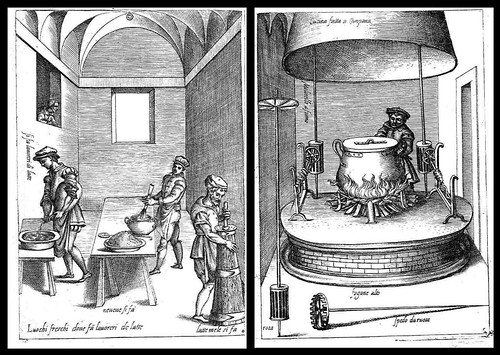 |
| Left: Cool Place for Dairy Products Right: Cooking under a Hood (Photo: bibliodyssey.blogspot.ca) |
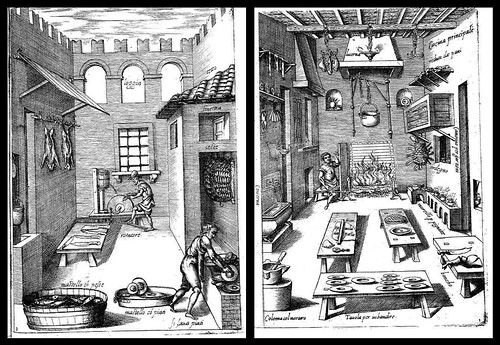 |
| Left: The Main Kitchen Right: The Room Next to the Kitchen (Photo: bibliodyssey.blogspot.ca) |
I do not know whether these depictions are representative of all kitchens in the homes of the wealthy or if this was simply the kitchen that was provided to a well known master chef as Scappi. We must keep in mind that he worked for Popes and Cardinals. What we can gain from this, is that most kitchens wished to keep their rooms separate like (it would be ideal). Yet, if we look back to Campi's Kitchen, it seemed that most kitchens were cramped as he portrayed rather than how Scappi is presenting the kitchens in his cookbook.
Bartolomeo Scappi Photo: https://en.wikipedia.org/wiki/Bartolomeo_Scappi
All other photos: http://bibliodyssey.blogspot.ca/2009/03/renaissance-kitchen.html
Scappi, Bartolomeo. The Opera of Bartolomeo Scappi (1570): L'arte et prudenza d'un maestro Cuoco. Trans. Terence Scully. Toronto: University of Toronto Press, 1570. Print.

No comments:
Post a Comment