Let's dive right back into the rest of Bartolomeo Scappi's books!
BOOK FOUR
Dell'imbandire le vicande
This book deals primarily with the preparation and serving of meals to men of notable status. Scully does mention how Scappi must have been present during important meetings and during gatherings of notable officials. I found that this is proven by one simple line, "you will often have to deal with stewards whom their masters have installed in their Office more as favour than for any experience they might have of that function." I say this line proves how present Scappi was, especially with his status as a master chef for wealthy families, because he offhandedly comments on the corruption of the government within the Italian city states!
Scappi states, for book four, it will be a list "of things that can be served from month to month, things normally eaten in Italy and particularly in the City of Rome." Scully does not translate the samplings of the menus Scappi presents (unfortunately). So, for the sake of brevity (and the possibility of horrid translations) I will present two portions of one meal. A Dinner on the 8th of April, with two Credenza courses and one Kitchen course, served in two plates, with two Stewards and two Carvers (Pranzo alli VIII d'aprile con due servitii di credenza, & un di cucina servito a due piatti con due Scalchi, & due Trincianti).
Primo servitio di credenza
Biscotelli di marzapane 2 piatti
Mostacciuoli Napoletani 2 piatti
Ricotte passate er la siringa servite con zuccaro sopra 2 piatti
Presciuto cotto in vino tagliato in fetter, servito con 2 piatti
sugo di melangole, & zuccaro sopra
Offelle alla Milanese 2 piatti
Secondo, & ultimo servition di credenza
Torte di salviata 2 piatti
Tore bianche 2 piatti
Carciofani cotti serviti con aceto, & pepe 2 piatti
Carciofani crudi serviti con sale, & pepe 2 piatti
Pere, & mele di piu sorti 2 piatti
Casci marzolini di due libre l'uno spaccati 2 piatti
Casci Parmeggiano in fettuccie 2 piatti
Mandoline fresche spaccate servite su le foglie de vitti 2 piatti
Neve di latte servita con zuccaro sopra 2 piatti
Cialdoncini fatti a scartocci 2 piatti
Ciambellette di monache 2 piatti
and the rest of book four goes on like this. The detail and attention, and even the fact that he recorded all this down, is simply amazing to me!
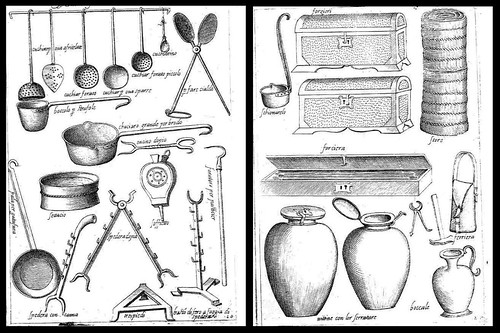 |
| Left: Kitchen Apparatus, 3 Right: Kitchen Equipment for Travelling (Photo: bibliodyssey.blogspot.ca) |
BOOK FIVE
Delle paste
This book is about the preparation of different pastries like, pies en croute, crostate, tourtes, twists, flans, pizze, lean pies, lean crostate and tourtes (lean being made mostly out of fish). To be honest, I thought that this book would contain a lot more desserts, but for the most part, the main ingredient is still a meat. There are turkey pullets in pies, a pie of a calf liver, and a prosciutto crostata (just to name a few). There are a sweet pastry recipes included in this section, we have recipe 124. Another way to prepare a filled twist
When you have made a sheet of dough like the one above, grease it with melted butter and sprinkle it with sugar and cinnamon. The get hard-boiled egg yolks beaten small and mixed with steeped pinenuts and raisins, and scatter a few little bits of butter on top of that. Make a twist and bake it as above in the oven in a tourte pan (one of the other ways to make a twist was using bone marrow!).
The reason why pastries were not just simple, sweet desserts may be a way that the people in the renaissance wanted each portion of the meal to be equally as filling. That is why a majority of these recipes are not simple by any means and always seem to contain a long list of ingredients.
BOOK SIX
De convalescenti
The dishes in this book are for those that are sick (a strange section for a cookbook, I say). Listed recipes are for prepared potions, concentrates, pastes, barley gruel, thick broths, thick soups, pies, tourtes, sops, milk dishes, eggs, dainty pottages, fruits, sauces, garnishes, jellies and confections. The list of different recipes is quite long, it covers a large range of dishes but each section does not have the large number of recipes as the other sections. As I read the recipes it seems that the main idea for most of them is to give a concentrated meal but one that was also easy to digest.
For example, recipe 58. to prepare a thin barely gruel
Get either of the above-mentioned barleys and clean it the same way. Cook it in a pot, with two and two-thirds litres of water for every pound of barley. Reduce it by two-thirds so that the remaining water is a tawny colour and thick. Put the barley into a filter cloth and immediately discard the water that comes through first. Carefully squeeze the cloth and tie it up; hang it over a nail and the water that oozes out will, according to Physicians, be excellent. To that barley gruel you can add melon seeds, reduced milk, and sugar.
I like how he mentions what Physicians say, it adds an air of authority and true evidence that his food will provide some relief to those that are ill. Scappi also has some simpler meals, like recipe 90. the prepare a thick spinach soup.
Get spinach in the spring, although in Rome you can find it an any time of the year. Wash it in several changes of water, taking the tenderest part. Sauté it in oil or butter or chicken fat. Then finish off cooking it in chicken broth and prunes. Serve it hot with its broth.
There is still a sense of this meal being fulling but it is simple and easy for one to eat and digest (I assume it would be a dish that is easier on the stomach as well!)
This concludes Bartolomeo Scappi's Opera! Wasn't it an exciting trip? I find that this much attention to detail may be a sign of master chefs throughout Europe, but I'm not too sure. I do know that in the mid 14th century to the early 15th century, in Italy, documentation starts gaining ground. You have the merchants writing every detail of their transactions (when, who, what, why) and we can see this with one of the most influential merchants, Francesco Datini (c.1335-1410). Who had an amazing storage of all his economic transactions that survived, in house. Perhaps the chefs are responding to this type of documentation in their own way by means of a cookbook. What better way to preserve recipes and one's own name?
Though in the case of Scappi, it seemed his station as a papal chef allowed him the means to write such a book.
His book is still a nice snippet into the dining rooms of wealthy courts, papal courts, and even at the side of ailing popes.
Photo: http://bibliodyssey.blogspot.ca/2009/03/renaissance-kitchen.htmlScappi, Bartolomeo. The Opera of Bartolomeo Scappi (1570): L'arte et prudenza d'un maestro Cuoco. Trans. Terence Scully. Toronto: University of Toronto Press, 1570. Print.